
Wonder Bread
Michael Wright on Corita Kent

“My friend Michael” is an oft-repeated phrase here, and yes, this is that Micheal, who hopefully doesn’t need much of an introduction at this point. But if you’re newer here, you’ll want to explore a few things he’s written, like this essay on Virginia Woolf or one of his Year in Reading entries. He has a great new piece on the dark side of Thomas Kincade in Mockingbird you’ll definitely want to check out. If you’re in any way interested in contemporary art and how we make meaning, go explore his extensive archive of writing about art and spirituality on Still Life. I can think of few others I’d want to accompany me on a trip to a museum. Michael drinks up art and history like a marathoner after crossing the finish line. I’m glad to call him a friend, and I’m glad I recently caught him freshly awash in the afterglow of a visit to the Corita Art Center in Los Angeles. Please enjoy! - Josh
“We have no art, we do everything as well as we can.”
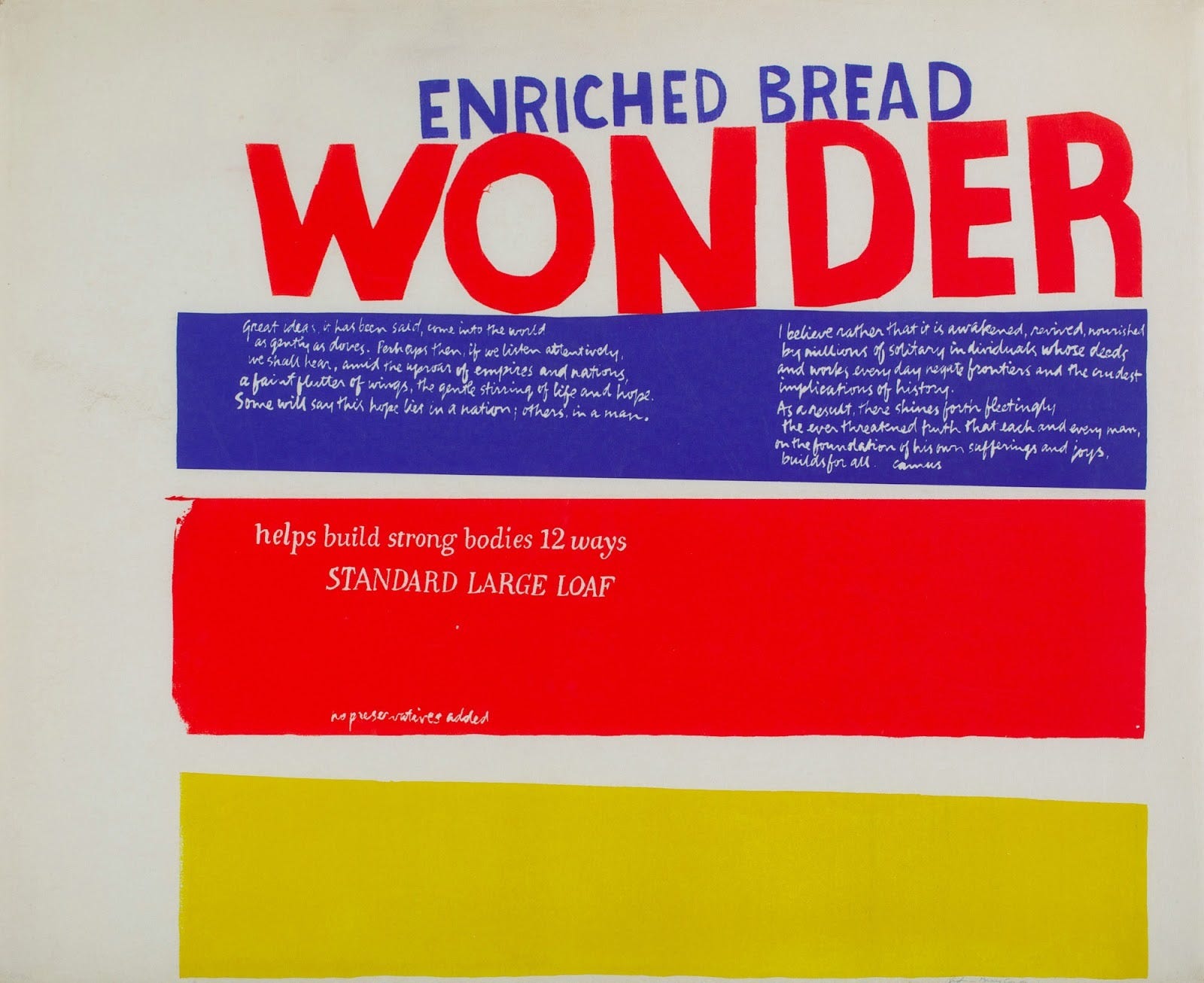
Why did Corita Kent, an artist-nun who led a college art department, repeat this Balinese proverb to her students? They might have been on a field trip taking photos of supermarkets or examining Mexican folk art. They might have been listening to Corita interview Alfred Hitchcock or Charles Eames in their Los Angeles print studio, or perhaps walking toward Hollywood in an annual Mary’s Day parade. And yet, at any moment, Corita would share that proverb: we have no art, we do everything as well as we can. In all of this joyful and creative community, what does it mean to have “no art” as a goal? One step toward an answer might be sliced bread, specifically the popular Wonder Bread brand the artist uses for subject matter in her 1965 serigraph titled “enriched bread.”
On the surface, the print is fairly plain: at the top, you can read “ENRICHED BREAD” and “WONDER,” text lifted directly from the food label. Below that: three thick bars of primary colors stacked in a column. In the blue, white hand-written notes by the artist; in the red, more food label language: “helps build strong bodies 12 ways,” “STANDARD LARGE LOAF,” “no preservative added.”
Working at the beginning of pop art, “enriched bread” might remind you of Warhol’s famous Campbell’s soup cans, an almost mythic series of screenprints that set the stage for the art style: a rejection of the “Fine Arts” for what’s blowing down the sidewalk, a swapping out of the “Genius Artist” for a more hands-free approach. Soup cans and sliced bread seem similar enough, but where Warhol celebrates the surface of things, Corita goes further. Yes, she gives us the all-American branding and bold primary colors, but that small scrawl in the blue? When we lean in, what do we see?
Corita hand-writes words from the French existentialist Albert Camus, lifted from “Create Dangerously,” a 1957 lecture on art and social life. He argues that artists must risk involvement in the world around them even in the midst of growing political violence—or risk losing their voices and integrity. It’s a somber and clear lecture, and it ends with a note of hope Corita copies directly into the screenprint:
Great ideas, it has been said, come into the world as gently as doves. Perhaps then, if we listen attentively, we shall hear, amid the uproar of empires and nations, a faint flutter of wings, the gentle stirring of life and hope. Some will say this hope lies in a nation; others in a man. I believe rather that it is awakened, received, nourished by millions of solitary individuals whose deeds and works everyday negate frontiers and the crudest implications of history. As a result, there shines forth fleetingly the ever threatened truth that each and every man, on the foundation of his own sufferings and joys, builds for all.
Even in the midst of political uproar around him, new things are possible and are, in fact, already taking root—even if the future is entrusted to people we haven’t yet met, working in the margins of the current culture. Corita writes these words directly into the screenprint, bringing Wonder Bread ad copy into conversation with Camus’ ideas and inviting us to reflect on how it all connects. What’s the relationship between wonder and great ideas and hope? What can nourish and enrich us today amid the uproar of empires? The closer we look, Corita’s artwork “speaks” less like a poster and more like a koan or reflection guide, creating new questions to live into.
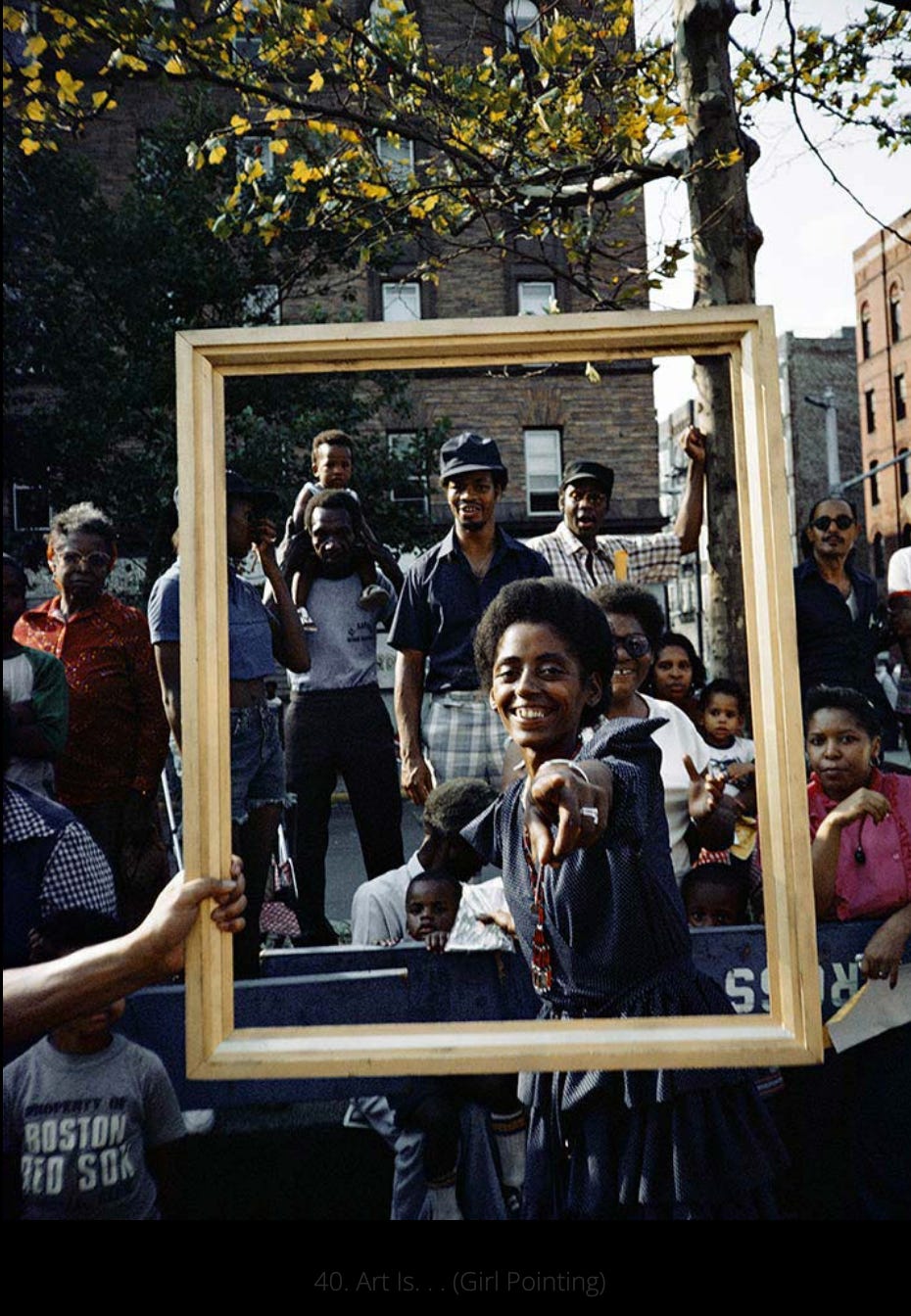
It reminds me of Corita’s famous “finder” exercise where she invites her students to hold up a small empty frame on the world, to give attention to something you may have missed, to let the world expand before you right under your nose. (This isn’t just a happy feeling, by the way. Our attention and our values go hand in hand, which has real social implications—take a look at Lorraine O’Grady’s “Art Is” project for example.) How do we practice seeing these “gentle stirrings of life and hope” around us? How do we practice a dignifying attention to each other?
There’s one last thing informing this artwork—something so glaringly obvious it’s easy to miss. Corita was a nun. For decades, she was a member of the Immaculate Heart Community, a Catholic order of nuns committed to social justice. In addition to her own reading and art practice, Corita was also informed by theology and church tradition. Any fellow nun or student seeing this screenprint in the window of the Immaculate Heart gallery would see “12” and “BREAD” and know what Corita’s referencing: communion, the ritual at the heart of Catholic life. “12” isn’t a list of nutritional benefits, it also evokes the 12 apostles surrounding Christ during a final supper before his crucifixion, a meal Christian churches around the world have repeated every week since then.
We may not share her commitments (Sister Mary Corita Kent left the order during a sabbatical and lived out the rest of her life in Boston as Corita—a story for another time) but this theology has profound social implications informing her work. What helps build strong bodies? Communion, companion, community—Corita references this ritual meal, reminding her viewers that at the very center of life together isn’t “us vs. them” but “all of us,” not a wall but a table.
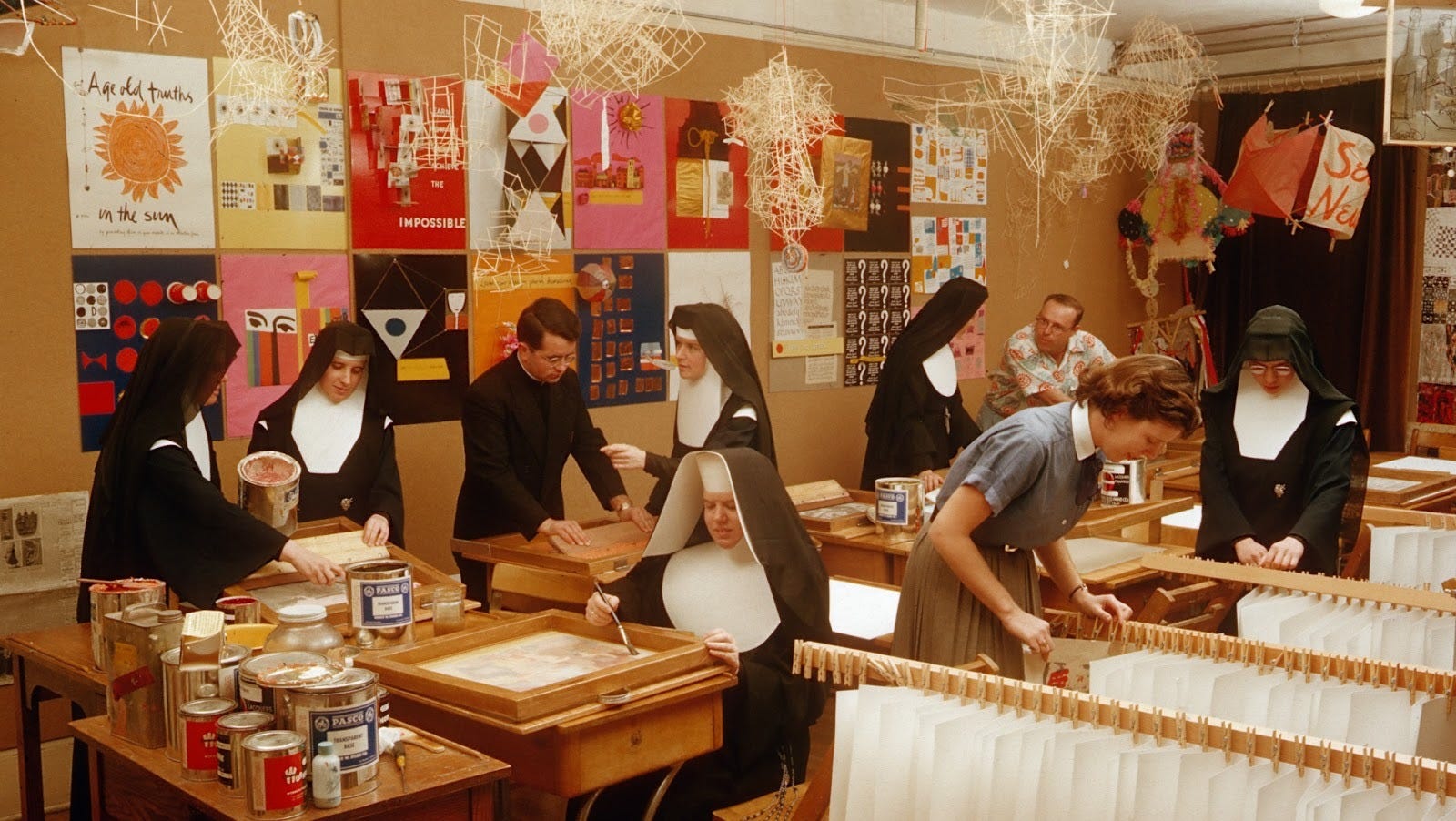
So, let’s go back to that Balinese proverb. We have no art? Corita isn’t asking us to relinquish our creative work or evaluate our own skills and put ourselves down. She’s inviting us to have a new set of values for how we approach creativity in the first place. “We have no art” means we don’t get distracted by trying to become an Artist or New York Times Bestselling Author or Academy Award-winning Actor or [fill in the blank]. We can’t over-identify with the role or the outcome: instead, we do everything as well as we can.
What is Corita doing so well? Not only producing artwork, but cultivating a community. Her screenprints emerge out of a way of creative living, and in a way, Corita’s “enriched bread” screenprint is like a Rosetta Stone for the rest of her work—She isn’t interested in “art for art’s sake” (we have no art). Instead, she invites us through the art to explore deeper commitments to friendship, spirituality, exploring big ideas, and curiosity. Or, to take her word for it, wonder.
___
Michael Wright is a Minneapolis-based writer and founder of Twin City Life. He has written for Contemporary Art Review Los Angeles, Mockingbird, and other publications. Explore his newsletter archive to read more of his writing.