
Avoidance & Work

“You don’t have to pretend you’re not scared / Everyone else is just as terrified as you.”
— Courtney Barnett, “Charity”
I probably have this secret belief that if I read the right book or find the right story at the right time or haunt enough bookstores that I will eventually find the ticket to inspiration, some talismanic upswing will take over, and I will emerge from the reading experience anew, turning around to polish that story I’ve been working on for months, and when I send it to the The Paris Review, they will be knocked out and my entire career will be made and I will finally be allowed into the Writers’ Main Event.
Joyce, more, Woolf, more, Morrison, more, Lorrie Moore, more, more, more.
I’m a glutton for avoidance. If I have a surprise free weekend and endless time to write, I vacuum. I clean a closet. I cycle through my watch list for two hours until I get so sick of not deciding that I just throw the remote across the room and go for a bike ride.
It’s no surprise that the root word for avoidance—void— stretches back to the 14th century and, as far as I can tell, means draining a vessel or emptying out the bowels. The act of emptying feels in some ways like a far cry from the noun or adjectival form. The void space. The yawning void. Lack. In the parlance of the day, we tend use avoidance—avoidant tendencies, avoidant behavior, addiction as avoidance—to refer to the action of inaction.
“Here I am, avoiding things again,” we say, from the depths of piddling, lollygagging, scrolling.
We say, “I need to stop avoiding preparing for this presentation [or doing laundry or taxes or making the art we supposedly want to make] and get to work.”
At the end of the long hallway of avoidance, there is a door, and that door is decorated with photographs of various seductions, but behind that door lies an empty room, which then leads to another hallway with another seductive door, and another, and another.
We avoid feeling left out, because we don’t want to be the only one at the party who hasn’t read All Fours. But as artists or writers—I know there are more than a few out there—we don’t owe shit to any person or trend. We don’t have to have an opinion on the latest Yesteryear.
What a joy.
Reading approximates writing. But: the work, the work. The laundry, the taxes, the presentation, the making. Reading doesn’t write. Visiting the museum doesn’t paint. Buying new running shoes and a fancy watch doesn’t make you run. It looks. It dreams. It gazes longingly. It approximates. It avoids.
In honor of getting to work—hey there, weeklong residency I’ve just arrived at as I revise this newsletter—I thought I’d share two of my favorite books about work. I’m not a list maker—you can go elsewhere for that—but if I did make a list, yes, Grapes of Wrath and A Far Cry from Kensington would be on there, as well as the office job classics like Then We Came to the End by Joshua Ferris, The New Me by Halle Butler, and The Pale King by David Foster Wallace. For my money, though, you can skip those and go straight to Lightning Rods by Helen DeWitt for a true satire about corporate cubiclism, which follows one man trying to solve workplace sexual harassment with a ludicrous idea. The novel reads like a joke that pushes further and further into discomfort until, finally, it says something (many things) true about how far we’ll go to exploit women’s bodies.
Last Night at the Lobster is a great, tender-hearted restaurant novel—yes, about Red Lobster.
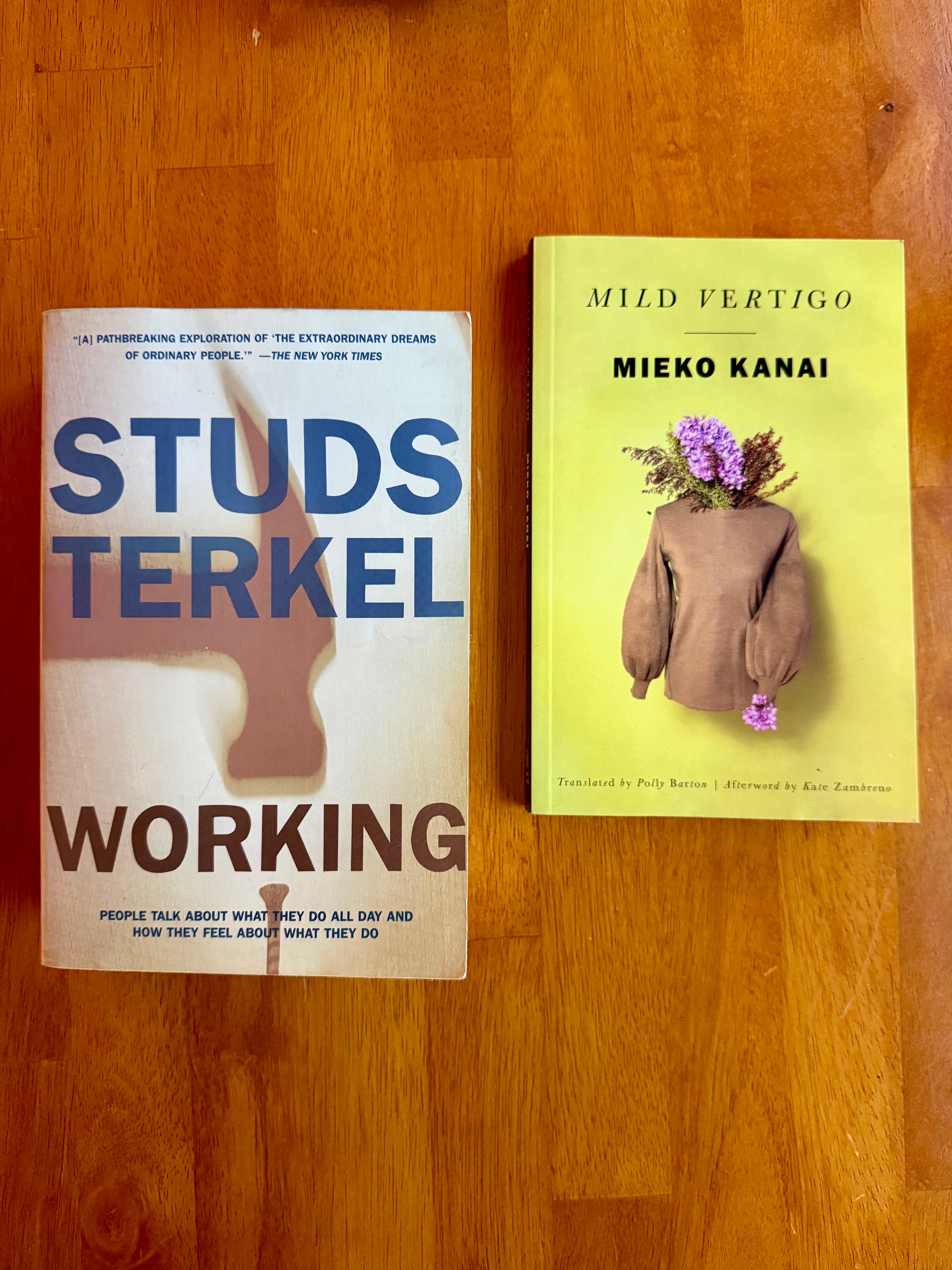
“Work” and our perception of what is worthy of that word is rife with sexism. Why don’t novels about housewives, househusbands, stay-at-home parents, or nannies get included in the “Best Work Novels” lists? Shame. Look no further than Mieko Kanai’s 1997 novel, Mild Vertigo, which details the monotony and, as the title suggests, vertiginousness of the daily grind of grocery shopping and taking care of two boys. The stakes are high in the sense that this might be read as horror. Beauty, comfort, and routine press in like constricting walls, and we’re left wondering if Natsumi will ever transcend her predictable, domestic duties or suffer something worse than the ever-present mild vertigo. Please allow me to channel my inner small-town Minnesotan aunt: oofta. As a partially domesticated, grocery-shopping, leotard-buying daddy, I felt this one deeply and intensely. Tread lightly, ye claustrophobes.
If I were a list maker, I’d definitely include Such a Good Man: Stories by Dustin M. Hoffman, whose protagonists run the gamut of the working class—plumbers, painters, roofers, and door-to-door salesmen, one of whom, so consumed with work and keeping his head above water, asks, “Who the hell has time to vote?”
I’d be remiss not to mention North Sun, Ethan Rutherford’s spooky, fairy tale novel about the twilight days of whaling. (Ahem, our conversation.) And then there’s the quirky, existential Convenience Store Woman, which I loved. Lucia Berlin’s A Manual for Cleaning Women has switchboard operators, emergency room nurses, laundromat loiterers, and tired, quick-witted mothers. Berlin is the story-writer for non-story readers. Sharp, minimal, razor-edged, poetic. Go get it, preferably right now. If I made lists, I’d probably pretend I’d read Germinal by Émile Zola, about coal miners, which seems, well, gritty. (Hardy har.) George Saunders’ deranged and disillusioned carnies and middling cubicle workers, menial laborers, barbers, and freaks hold a key to my heart. Hear ye: if you haven’t read Saunders, you should probably unsubscribe from this newsletter. (Again I say oofta.) Souvankham Thammavongsa’s Pick a Color is a profound meditation on the unseen workers of nail salons, who exist to appease and beautify. The main character, a former boxer, unknowingly casts about for connection. In an interview with Electric Literature, Thammavongsa says this:
My dad always told me he never had to worry about me. That I would always find my way. For a parent to say that to you, I think, is an incredible compliment. I was really down and out, preparing taxes by myself at a kiosk in a Wal-Mart when my dad said this to me. Whatever life was going to give me, I would find a way to love it and to do my work well with incredible pride. I wanted to read about a person like that.
Of all the working-class people I grew up around, I’d venture to guess all but one took pride in their work, took pride in their ability to quickly change a tire or a serpentine belt, to snap chalk lines for floor trusses or braze pipes for gas lines.
If I were a list maker, I’d end my list with Studs Terkel’s Working, the greatest book about work. Turkel is something of a legend in certain literary circles. Working, originally published in 1974, profiles workers of all kinds, from receptionists to actors, from welders to pharmacists. In his introduction, Turkel says:
This book, being about work, is, by its very nature, about violence—to the spirit as well as to the body. It is about ulcers as well as accidents, about shouting matches as well as fistfights, about nervous breakdowns as well as kicking the dog around. It is, above all (or beneath all), about daily humiliations. To survive the day is triumph enough for the walking wounded among the great many of us.
I’m sure more than a few of us know more than a few walking wounded. They are more often than not the very workers who might never experience the painstaking luxury of avoidance.
+++
What are you favorite books about work?
As always, please spread the love to your local libraries, independent booksellers if you can, or shop online at Bookshop. Thanks for reading.
It's not a book -- but the Starz series "Party Down" has a lot to say about the indignities of employment. Individual short stories, Jim Gavin's "Costello" and Kevin Barry's "Fjord of Killary" are also both knockouts.