
Twilight Zones
An Interview with Ethan Rutherford

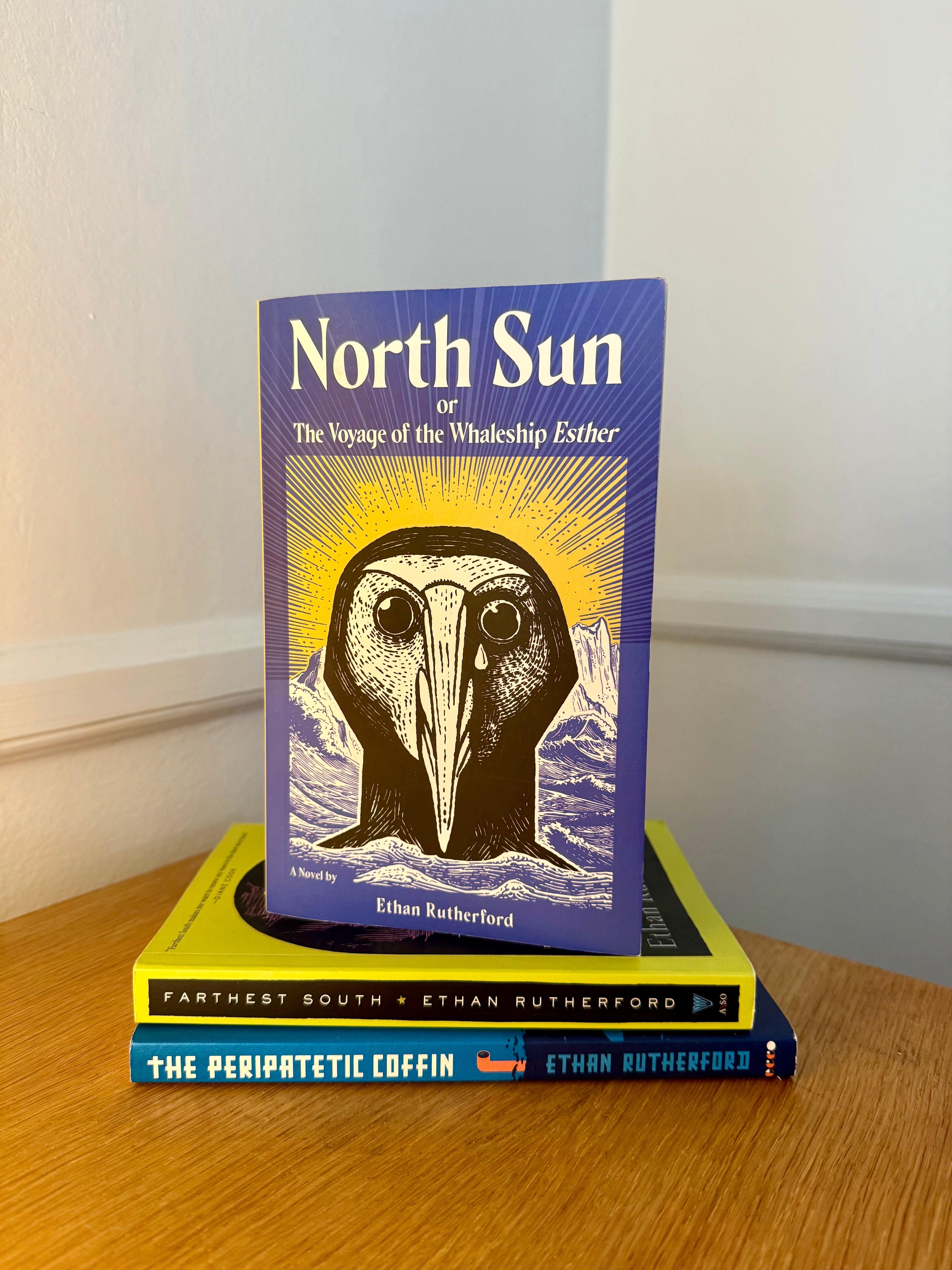
When I first discovered Ethan Rutherford’s work—some fifteen years ago—I was immediately reminded of Jim Shepard and Ursula K. Le Guin, writers with great formal and emotional range. The Peripatetic Coffin and Farthest South, his two story collections, contain multitudes: Magical fish, Confederate submarines, Arctic disaster, foxes adopting children, talking penguins, babies born with gills and brought to Lynchian maternity wards—all this alongside quietly funny, Cheever-esque domestic realism. His new novel, North Sun, follows a crew of whalers aboard the Esther. The seas become scarcer and commercial oil production is in its first boom phase. The men are in search of whales, yes, but Captain Lovejoy has been tasked with finding Benjamin Leander, captain of another ship that crashed in the Arctic. The story also follows two boys, deckhands, as they come of age and navigate some trauma with the help of Old Sorrel, a magical half-bird, half-man. North Sun is a ghost story, an ecological fable, an adventure tale, and a coming-of-age novel all in one, and it reads like a long prose poem or film score. Imagist descriptions and shunting lyricism drive the story forward in sharp and strange short chapters. I’ve never read anything quite like it. I spoke with Rutherford via email over the last few months on the heels of some great news about the book: it was shortlisted for the National Book Award, long-listed for the Pen/Hemingway, and it was chosen as one of Barack Obama’s favorite books of 2025.
I understand that North Sun evolved from many conceptions and iterations. Can you talk a little bit about that evolution? This began as an Alaska novel, is that right? Was it ever set in our world as we know it? Or did you always know there would be half-men, half-birds?
The process was indeed iterative, and my working cycle, in retrospect, went something like this: try something, realize it doesn’t work; try something else, sit with it, realize that doesn’t work either; try a third thing, see if it melds in any way with an earlier idea, realize it doesn’t; and then, in frustration, spend a lot of time looking at photographs of waves (Oceanscapes: One View, Ten Years by Renate Aller) and making room for intrusive thoughts like: what if each section of text was like a photograph, and framed, somehow, on the page? I tried that one day, liked how it looked, and then suddenly I think I had my mode: sit down, be patient and open, try to move forward; and when stuck, ask a series of questions—“what if, what if.” Don’t over-think, just layer paint like you would on a canvas, and see what comes through most forcefully.
So to your question: the novel did begin as an Alaskan novel (that is: very much rooted in our world, if historical, firmly in the Alaskan whaling grounds), and my goal was pure, lyric naturalism on the page. But I hit a snag, and the book felt quite static and boring and one-note to me. So I just sat with it, put it aside. And as I was trying to figure out what could be done, I remembered that what actually got me excited in the first place was the idea of some force working against the brutality of the hunt (this, perhaps, was wish-fulfillment on my part). And then, one day, for no reason I can remember, I wrote a scene where the captain dreamed of a terror-bird scolding him for all the senseless killing they were doing; and then I read up on maritime folklore, and stumbled on the story/idea of the Klabautermann, and got excited about some elements of that (namely that a goofy little spirit might swim aboard a ship, cause a little trouble or help out, but only be visible if the ship were doomed to sink). But I knew I couldn’t use a German folktale, because the crew was American, so I sort of dropped that. But then, I thought about some other characters in the story and what they might need (the boys, and what they were going through, and that they could use some protection). And then, one morning, Old Sorrel was born. He just climbed out of the sea. I was surprised but I shouldn’t have been; I was stitching him together from my own interests and obsessions without really knowing why.
This might be a little too in the weeds? I suppose it’s easier to say that one thing this book taught me is the extent that fiction thrives on interruption—and if something strange and compelling knocks on the door, and it seems like it might rattle the walls a bit, and become a vessel for another stratum of thought and experience you yourself hadn’t quite considered, and this intrusion gives your otherwise stuck-in-their-mode characters something immediate to respond to—even if you hadn’t planned it this way—well, why not open the door and invite that thing in and see what happens? What happened, for me, when Old Sorrel appeared, was that I finally, finally, understood what the story could be, and I attached.
Oh, I love this. It reminds me of that Flannery O’Connor quote we like to float around: “The writer can choose what he writes about but he cannot choose what he is able to make live.” It makes sense to me that the story found its wings when you invited in the fairy tale element, since so many of your stories contain magical or mythological elements. Have fairy tales always been important to you?
You know, I just heard someone else mention that O’Connor line, and it’s so perfect. What a great distillation. It floats around for a reason! I do wish it had floated to me a little earlier, it would’ve saved so much time. And yes, I suppose I have always found fairy tales appealing. What I like about them now is the same thing I liked about them as a kid. When you read in these genres (fairy tale, myth, etc.) it’s like you’ve opened the door into a land of steep consequences. Things are dire and immediate. And the world is monstrous, and full of nightmarish imagery, and unexpected transformations, and authority figures you 100% cannot trust, but there are also (usually) rules to the game. Like: if you do the five things this talking cat commands you to do, your father will live. I like that in a story. I find it simultaneously stabilizing and destabilizing.
Was that what you were trying to get at with writing this particular time period? Whaling is coming to an end, and the world is changing rapidly. “Petroleum is cheap as nuts, and its quick extraction has begun calling forth a new age. The railway has connected the oceans, and folds time itself.” Or, what was it about this particular time period that drew you in?
Yes, that’s it, exactly—I was looking for time to set the book when things did feel pressurized; and for whalers, the pressure wasn’t really felt during the golden age, when whales were everywhere and the price of oil was high, and everyone was buying and getting rich, etc. (though of course it was still miserable, brutal work). But what happens on a ship when you aren’t finding any whales (because you’ve killed them all), and you aren’t making any money (because you aren’t finding any whales), and you have to go farther and farther into some truly bleak territory (the Arctic) to fill a hold, and then after all the work to do this, you come home and realize no one even really wants what you’ve essentially put your own life on the line for, so the money isn’t what you thought it would be, and you’ve butchered all these majestic creatures for no reason at all (not that this was really on the mind of many whalers at the time)…It’s the downslope of capitalism. And it’s in these twilight periods, as one age turns to another, and a bunch of folks are hanging onto the way things used to be for dear life (despite knowing the harm caused)—those are the zones I like in fiction. It’s here when the consequences of various expansive actions make themselves known and become truly visible and shaming. As my dad might’ve said: it’s when the chickens come home to roost (morally, spiritually). And yes, of course, fiction is about cause and effect (that’s plot!). But the fiction I like is also a fiction of consequence.
I feel like we are at a moment of steep consequence now, particularly regarding the way we have ignored the warnings of our impending man-made ecological disaster, and are just going full steam toward the obliteration of tomorrow for the conveniences (or politics) of today. We just seem to lack the collective will to be different (likely because there is money to be made) and it’s going to be the end of us, I’m convinced. That’s what was on my mind, most of all, as I was thinking about North Sun, and the book I was hoping it would be. So I tried to find a time period that chimed with where we seem to be now, and it was in that twilight zone, historically, that the book felt most alive to me.
But also, honestly, and this cannot be overlooked: I also just love wooden boats, and rope, and thinking about living on a ship, and whalecraft, so I was in some ways looking at a very narrow period to inhabit (maybe 75 years). And I felt lucky to find it, and the emotional overlap there. And then I worked hard to make the book slightly more hopeful, and more tender, than I’ve just made it all sound (because I do have hope, I really do).
I’m curious about your research for this, which seems like a fair amount. Was there anything that really surprised you about whaling as you went along? Or something that demanded to be woven into the story you weren’t expecting?
Oh, I read so many books, and looked at so many maps, and spent a summer at the library of the New Bedford Whaling Museum reading the logbooks of whaling voyages (that museum is so great, go if you can!). I am not exactly sure, now, what I was looking for, only that I felt like full submersion would be the way to go, and the thinking was always: well, even if this comes to nothing, there are worse ways to spend time! I did not anticipate the way the language of those logbooks would influence the language of the novel—the herky-jerky syntax, for example. Nothing I’d written before this really moved with “end-stop” and “veer” (those were the words I kept in mind as I wrote) the way the passages in this book do.
But the one thing that did surprise me is that I didn’t know if I had a book to write until I read about how walruses were hunted in the Arctic. I was shocked at the brutality, and the work involved, and just the pure, almost rage-filled killing done by the whalers (in the accounts I read). I was completely devastated by the various stories of the way they hunted these gentle guys. And in many ways, I wrapped the entire book around it. It’s that moment that deeply upsets Old Sorrel in a way the other scenes of violence did not.
What’s interesting to me now (and also thank you for the question, because I never get to talk about this part) — I think the walrus scene in the book takes up two pages. Maybe three? Way at the end? It’s easy to miss, perhaps. No one ever asks me about it. But that scene is the Nabokovian nerve for me, or at least, it’s where I found the gravity I needed to spin the rest of the story around. And THAT came directly from research—just reading until I stumbled over something I’d never heard of, or even considered, before. I had dreams about it for months. And in some ways I wrote to get that knowledge out of my own body and on the page so I could look at it a little more clearly.
In some ways, the novel feels like it belongs to the boys, the deckhands of the Esther. They are the only ones who don’t enact cruelty on other beings—animal or fellow man—nor do they have ulterior motives of money or power. Everyone else on the ship (Captain Lovejoy, Thule, the depraved seaman Eastman) has their figurative white whale, but the boys’ innocence is tested and exploited, and in a way their relationship to Old Sorrel, this mythic bird-man, is almost like storytelling itself. The myth and the magic keep them alive, and their steadfast belief in the story of Old Sorrel gives them hope as they experience some trauma on board. Is this at all how you were thinking of the boys? Are we to read them as stand-ins for the most vulnerable among us?
Ah, yes, that’s such a lovely reading (!), and that is how I came to think of the boys, and their relationship to Old Sorrel. And I do think the story belongs to them (I’m glad you feel that way, too). Without them, and their relationship to (and faith in) Old Sorrel, and the tenderness they have for one another, the book would feel…too relentless? Or one-note? There’s no book without them; they’re the novel’s beating heart, I think. It’s important to say that they do have their own appetites—they hope joining the Esther will pull them from their bleak prospects ashore, and they want to have what they imagine will be a grand adventure at sea—but they come to be horrified by the hunt, and what they, themselves, endure at the hands of Eastman. One way I’ve come to find my way into the books I love has been to ask the following questions (among others, but these have been helpful to me): what is this novel critiquing – and what does it celebrate? I think the critique embedded in North Sun is clear enough (at least, I hope it is!). But what it celebrates is a slightly trickier question, and for me, when writing it—well, it sort of clustered in what you’ve identified. It’s a book about suffering of course (animal, and human), but it’s also about the transit through suffering, and the role that tenderness, and imagination, belief, and storytelling can play in that.
At one point, in the drafting of this book, a reader said: it’s confusing at times that they are referred to as “the boys” rather than by name (they do have names, but the names are mentioned only once). And I tried to address that by using their names in a more standardized way, but it…didn’t work. Naming them separated them from one another, somehow, in a way that felt wrong. And I came to like the idea that no matter what happened to them on this voyage, they would never pull apart. That closeness became increasingly important to me as the book went on.
I know music is pretty important to you, and you used to (or still do?) play it. Does it ever interact with your writing? Are you listening to music while you write? What musicians have been important to you over the years?
Oh yes. Music is the most important thing to me, as far as my writing goes (or, I should just say it: as far as my life goes). I’ve written a little about that here. It’s hard to really put this into words. I’ve always been an over-thinker, tightly wound, worried about everything, and I think what I discovered when I was young was that when I listened to music, I felt opened up—some guitar chord or some song or some lyric would plant in me, and it operated like an invitation: to feel something, to unbutton, to imagine a whole world. It was cathartic and it was interesting and sometimes obliterating. Certain songs, for me, just made up a strange sonic scaffolding—they built little houses, and I could walk around safely in them, feeling things I had no idea I was capable of, or interested in, feeling. And then they were over, but because they’d suggested a certain darkness or beauty I wasn’t aware of and couldn’t fully forget, I felt like my contact with the world had been ever so slightly enlarged. Later on, when I began to read seriously, I found that certain novels had the same effect. I still think, when I’m writing, that what I’m really trying to do is make a song that someone else can inhabit. My job is to suggest a world, to build a little house, and invite someone in, to nudge and suggest, and then get out of the way and leave the real imaginative work–the world building, the emotional swell—that strange personal connection that has more to do with the memory, desire, and mystery depths of the reader than anything I’d intended—to whomever feels open enough to listen.
With North Sun, the record that was the absolute most important to me was Ocean Songs by the Dirty Three. I listened to that record when I was stuck, I listened to that record when things were cooking. I was trying to write a book that would go with that record, a companion of sorts, in some alternate world where they’d asked me to do it (they definitely did not ask me to do this). I think that record likely suggested nearly everything I came to love about North Sun. It’s an instrumental album. And sometimes I felt like what I was trying to do was write the liner notes, lyrics that weren’t there, but were buried somewhere beneath the surface of that perfect record. Many other records influenced the structure and tonality of the book, too (Peter and the Wolf, Disintegration Loops, etc), but that one was the beating heart.
And since I was young, Lou Reed has been my hero, and he always will be. But I don’t think that one tracks as clearly across the page.
Lastly, congrats on all the success of North Sun! National Book shortlist, Pen/Hemingway longlist, Barack Obama’s end-of-year list — how does it feel? And what’s next for you?
Oh, it feels amazing. Surreal! But the happiest sort of surprise. I’m back now to writing stories—first love!—and it’s nice to work for now on a smaller canvas. But every once in a while I think: I wonder how Old Sorrel is doing, and what he’d make of the mess we are in now? We’ll see, we’ll see. Thanks for these lovely questions. This was fun. Sending all good thoughts to you from Barcelona.

Ethan Rutherford is the author of The Peripatetic Coffin and Farthest South, story collections, and the novel North Sun: or, the Voyage of the Whaleship Esther, which was a finalist for the National Book Award in Fiction.
Great interview! Thanks for sharing.