
Wild Things
An Interview with Nora Lange

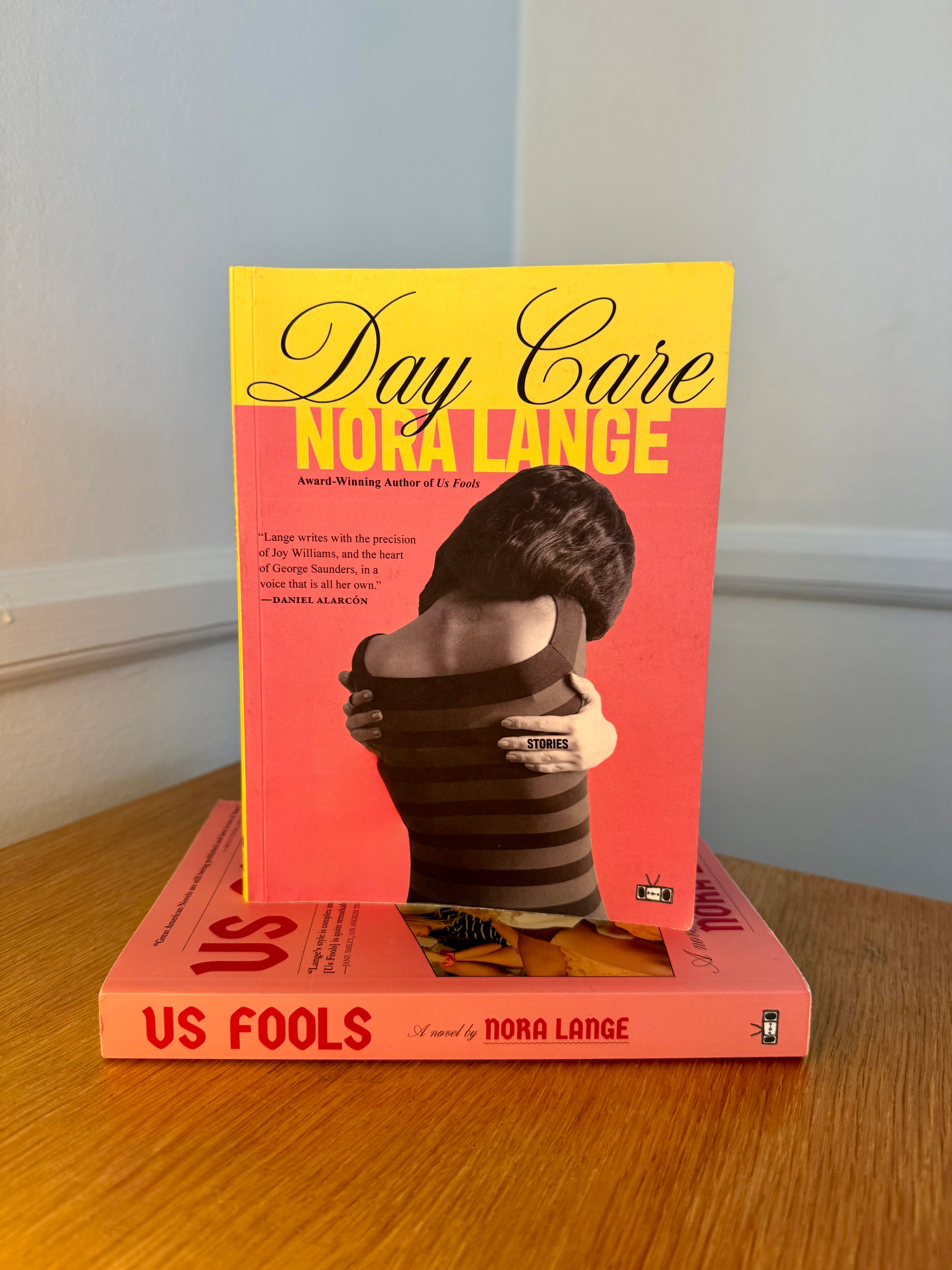
When I first sat down to read Nora Lange’s debut novel, Us Fools, I didn’t get very far without texting friends. “Have you read this?” I asked. Whole pages and paragraphs had suffered marks and scribbles and exclamation points. The novel follows two sisters, Bernadette and Joanne (Bernie and Jo), as their family grapples with the Illinois farm crisis in the misogyny-soaked Reagan 80s. Debt threatens to crush them as America’s priorities shift to celebrity and doublespeak becomes the norm. Homeschooled, the sisters rebel, fixating on Greek mythology and Sally Field. The novel is capacious and intimate, incisive, and laugh-out-loud funny if you understand Midwestern sarcasm. (Of course you do, that’s why you’re here.) Bernie narrates, saying, “I resigned myself to being second in line in terms of importance, which was fine since I was already a copy of a copy.” This line might also be found in Day Care, Lange’s new collection of stories, which came out on Tuesday from the fantastic indie press, Two Dollar Radio. Though that same theme of containment carries over, the stories exemplify a skillful shiftiness of form, from stream-of-consciousness fever dream to eco fable to what you might call body surrealism. A husband and wife attend a dinner party and speak through texting, waiting for a fellow tired parent to make something interesting happen. Two figurines caught in a man-made snow globe seek to escape their "purity script” and dream of transforming into octopuses. The young mother in “Last Boob Feed” says, “I am a guest in my life.” How do we get free when the systems are stacked against us? How do we become agents of our own lives? These stories had me thinking of these questions and more for the many days and weeks after. I hope you enjoy my conversation with Lange, conducted recently over email. - Josh
You’ve mentioned that you often “hear” a character’s voice before you see them. Was that the case or for both the novel and this new collection of stories? What are you hearing exactly? Their inner monologues? An exchange of dialogue? The voices in their heads?
Us Fools, the novel, was most certainly an auditory experience first. To be fair, I was in the sound department as an undergraduate and spent my nights editing in a dark sound studio. So to “hear”, as an impetus, wasn’t all that surprising. It was more when the voices didn’t go away, that’s when things got interesting…
As for the collection Day Care, these are stories that span years, fifteen, maybe more. In that sense each is a time capsule which represents a different part of my life as a writer. To get more specific, I wrote “Dog Star” during Covid. At the time, we were living in a small apartment in Portland, OR, to help out with my family (and we could do our things remotely), and I was working on Us Fools. The story of the two close female friends in “Dog Star” is in many ways an extension, resembles, or is a retelling of a kind of the close relationship between Jo and Bernie in Us Fools. Whom I did hear, as I mentioned. When it came to “Dog Star,” I couldn’t get the sense of the environment, their (the two characters) containment out of my mind. It was haunting. They were haunting presences which I didn’t hear, but felt. I felt the need to explore these confines. And the story became a way of exploring this idea–of growing up inside of a snow globe. That thing which is created to foster nostalgia in a fragile authenticity-seeking tender way but which is an object of creation for purchase. Therefore, instead of the Midwestern farm crisis of the ‘80s, and government policy catastrophes, informing psychopathy—this is a story about two females growing up inside of a snow globe whose entire world has been invented, whose entire world is continually altered, picked apart, corrected, molested, by those “forces on the outside.” So the two characters dream, which is radical (politically and emotionally), which is a thing I feel a lot of my characters do: they dream to move the confines in which they find themselves.
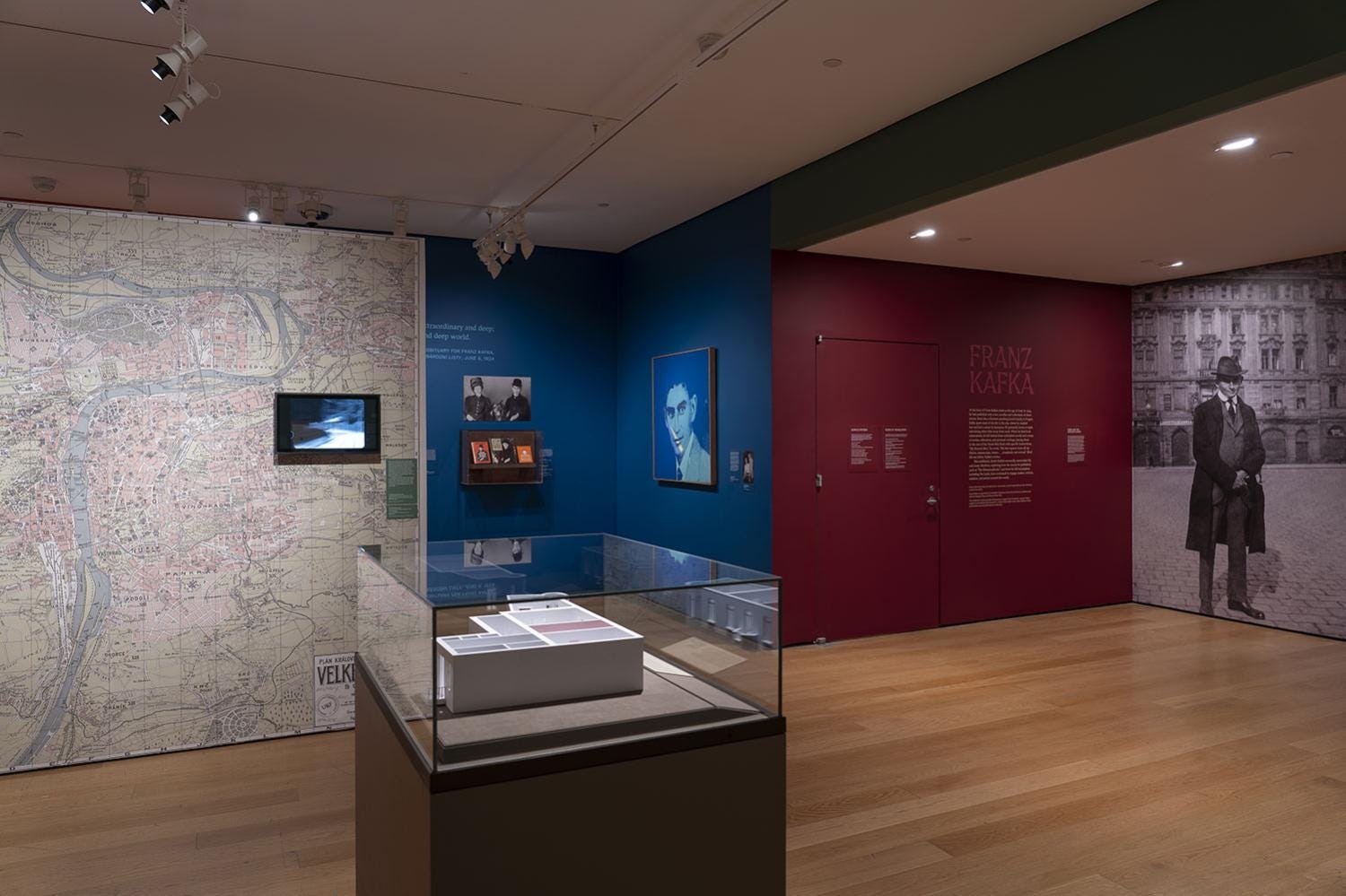
A friend of mine works at the Morgan Library in New York and in 2025 she put together an exhibition (incredible) on Kafka. In it, there was a diorama, a small-scale replica of Kafka’s living arrangement at his parents’ house in Prague. A viewer sees in the installation that Kafkas’ private corridors were anything but. His room, or space, had to be traversed through in order to reach any other space. To use the bathroom, a family member would need to move through Kafka’s room. What’s revealed in this, at least what was revelatory for me, was that the writer’s space can inform a story or books’ environment. In Kafka’s case, his lived experience of a cramped quarters informed The Metamorphosis. I share this only to say that I felt this way too during Covid, but it was through Kafka’s diorama that I was able to self-reflect, to acknowledge that those limitations on space and sovereignty impact and inform the mind and therefore the writing.
That containment feels like a big theme of the stories. In “Dog Star,” the Figurines’ lack of eyelids symbolizes their inability to look away from their own exploitation. They are designed to be seen rather than last. The narrator in “Last Boob Feed” says “I am a guest in my life” as she tries to reconcile her identity as a new mother. In “Hot Spot,” a young writer—the “starving artist” — is beholden to her older brother, a corporate executive. I’m curious about your fascination with containment. Did your thinking about agency change over the course of writing these stories?
I think that’s right, containment vs. freedom or liberation. When an environment is constrained, what happens to a character’s breathing? Or to put it more mildly, flexibility. I think too there are questions around intimacy in these works. In some ways, intimacy might be considered a cousin to containment. Like camping in a tent, being on a plane, bowling in rented bowling shoes.
It’s interesting to read your paraphrase above of the figurine’s eyelids. It registers for me as very grotesque. Which it is. It must be, right? In writing this story I felt that I was simply there reporting the facts of their world. An odd admission, since it could be said that I created them. But sometimes I am not so sure. I am not sure it can be simply said that I created my daughter, for instance. The circumstances were aligned such that she was conceived, of course, and she would not be without our materials, but she is herself, fully. And I am along for the ride. This is not to say that I don’t nurture or care for her. I wipe her butt. I read to her Where The Wild Things Are. It’s only to point out that sometimes (often) we overestimate our egos. In other words, our originality. Our sense of authenticity. We are composites, amalgamations by nature. And “Dog Star” was a story in which I was invited to join, not the other way around. And it took me a very very long time to make sense of it.
“Last Boob Feed” was a fever dream. In fact, writer and pal Justin Taylor when he read it had those very words to say. And I wrote it in that fashion: feverishly, between feeds—which is to say mid-worlds. I wasn’t sure if I’d ever sleep again, or feel awake again, and so I ran into it and there was no other side, just a wall. Anne Carson, speaking from memory about her book Plainwater from the ‘80s recalls the characters in it who live in a wall. In Medieval times it was tradition for “a woman seeking penance to wall herself up in the wall of a house and live in the hole, as a religious exercise in order to atone for sins, or undertake prayer, or who knows what,” Carson explains. We understand that the women would pass their lives with very little movement like a Jack-in-the-box toy or meme, subsisting on whatever people passed them through the hole. Carson goes on to say about pilgrimages, like the one she discusses in her essay on the Road to Compostela, that these decisions are a kind of freedom but are also a kind of bondage. And in many ways this highlights the complexities in the idea of containment, as you’ve asked about. It surfs the complex boundaries of liberation. “Last Boob Feed” in particular, sleep deprived and nuts, my sense of agency became more deeply rooted.
In “Hot Spot” I really want to lay bare that teeter totter power dynamic when one person owes another. This story is about a brother and a sister, both dependent on one another to varying degrees and for different reasons. In the story, the monetary power–and what it offers—is what holds the younger sister captive to the brother, as he loans her money. It is this arrangement between them which restrains her. But the dynamic between them is also humorous, and of course more layered than what I’m describing here. She has a shifty, bendy power herself. In that the younger sister has another kind of hold over her older brother which is not rooted in money. She eats what she wants. Lets her belly hang. She spies on the park. Whereas the older brother –married, burdened, rich, lonely, sick–might long to do but he cannot. He is beholden to the idea of himself in the mirror–and he is drowning, even if the mirror is a fancy one.
One thing I think you do so well with the characters of Day Care is portraying characters who are aware but only up to a point, so their impulsivity—putting snails in their mouths, playing extreme versions of spin the bottle—reads as authentic to their alienation. Can you talk a little about that process? Is it tricky to inhabit that state of mind in a character? Is it ever tempting to imbue them with more self-awareness?
Yes, it is definitely attempting to imbue them with self-awareness by firmly placing them in relation to their (or others) body. It is a centering device. It’s the end of the day swirl of water taking the detritus in the sink down the drain. The snail she puts in her mouth, as far as she is concerned, belongs there. If only to remind her of her relationship to the outside world as it meets her internal world. The snail is her secret. And the snail with her feels friendly, soft, and good slithering along her jowls as she is about to enter her old high school for her reunion. To be clear, her intention is not to harm the snail. She will not harm the snail! She is embracing the snail, privately, up until a point (to borrow your phrasing).
In my own life, such as it is, I appreciate playing games. I am a lover of UNO. Granted, not very sexy, but I do think we talk about ourselves much too much. Give me a game after dinner, provide me another focus, outlet, opportunity, other than continuing to perform the loops we circle. Alternatively, I welcome a challenge to my comfort, like reading “scripts” at a dinner. I have turned several of these stories in the collection into performance, play-like “scripts.” (I am using the quotation marks here to denote my work’s unprofessionalism.) It’s really very pleasurable to read aloud and to listen, together, with people. And then to switch “roles” and read another character? Even more fun. To explore something, to laugh? Yes, please. If I could spend my day exploring, fuck yeah I would.
I’m curious how you think about the surreal in your stories, which can range from elements like mysterious rashes and squirrels with erections to alternate universes like figurines in snow globes. And then we have a few stories where reality is slightly atilt, like in “Distrito Federal,” where extreme violence occurs almost matter-of-factly, or in “Last Boob Feed,” which has that fever dream quality you mentioned. Do you begin with surreality in mind, or does that emerge organically? Or is genre not even on your mind?
No. Genre is not on my mind.
I had an interview the other day at the Tanner Institute, at the University of Utah, and the interviewer remarked how gross it was that the character in “Letting the Snails Go” had put the snail into her mouth. “Was is gross?” I wondered aloud. I find it delightful, I added. And not farfetched at all. There was silence!
Again, I wonder if this has something to do with my proximity–close, very–to the characters I am writing with and the lives they are leading, such that there’s a naturalness to their movements which I do not find alarming, but perhaps I should.
In terms of writing and genre, the points of thought I’m attempting to observe, push, flex and that I am aiming to articulate are top of mind. This isn’t to say I don’t follow recipes, but I also think a lot is intuitive. I also think you do with what you have on hand, if I’m continuing the lethargic cooking analogy, which is dumb and silly and therefore I shall not delete. Everyone has a kitchen and does stuff in it from time to time…(This is my second kitchen reference, I do believe. Revealing that I cook a lot, lol.)
“Distrito Federal” is an altogether different kind of exercise. It’s a silhouette of time and space, violence, home, and cigarettes. And player pianos. Almost like one of those connect-the-dots images. I could, and perhaps did, imagine it as a John Cage improvisation. Which isn’t to imply that the story is unstructured–it has its own distinct logic, I do believe. But it’s a more atmospheric and sensory piece, on a sonic and tonal level, if that registers at all. Though I do not want to limit a person’s interpretation of the story…
That’s really interesting. I guess as I was reading I thought of those “gross” moments as bodily maps of trauma. As in, the gestures (the snails) and the bizarre happenings (mysterious rashes) are explicable or believable because the repressed, contained or otherwise stifled character is looking for a way out — or maybe freedom from within the containment. Does that ring true at all?
Absolutely. Rings loud and clear, yes. Those instances, those gestures, which might otherwise on the surface appear grotesque are the “natural” outpouring, or result of another sort of instance that has occurred. Which in many cases predates the “time” in which the story is taking place.
I was asked today about Joanne and Bernadette’s ages in the novel, Us Fools. The implication was that their “precocious” behavior (that the two sisters engage in, within the novel) didn’t match their young age. The question was what would I say to those readers who expressed as much? Well, then they haven’t met them yet–was my answer. I refute the idea that what we believe, think, feel we know is the totality of what is out there. That is a failure of curiosity and I refuse it.
Your thoughts above are effervescent to me, is the short answer. Wink.
How does that saying go? “…to know that we know what we know…that is true knowledge.” Something like that. Speaking of things you probably do know about, can I ask you about Ovid? He comes up three or four times in the collection and a handful of times in the novel. Are you an Ovid devotee? Or what is it about his work that draws you in?
…and to know that we do not know what we do not know, that is true knowledge.” –Copernicus
Ovid’s poetry remains unsated, which is compelling. It is hunger-driven despite its age (old). A poetry map of space and species, and absolutely worth returning to. Metamorphoses equals DNA. As do the Liang Metanduno cave paintings, Prussian Blue, Mayan temples, Red Dye No. 3, Johannes Vermeer’s “Girl with the Red Hat,” a color often considered the first when it comes to painting. I am eager for Jhumpa Lahiri and Yelena Baraz’s co-translation of Ovid’s Metamorphoses to be released. (I have been partial to Ted Hughes’ translation.)
“A poetry map of space and species” is a really lovely phrase. If there is a Nora Lange DNA (are we using this interchangeably with “canon”?), or if they are indeed separate, who or what makes it up? I know Joy Williams is really important to you.
Anne Carson, Maggie Nelson, Percival Everett, Franz Kafka. Honestly, not to sound like a cop out, but I feel a deep affection for many writers. I will say I just finished reading The Dry Heart, by Natalia Ginzburg–and if my writing is considered dark, then I am certainly not alone in this impulse.
You mentioned in the Year in Reading series that you’ve been reading and rereading Austerlitz and Trying to Be for a research project. Care to share what that is?
Trying to Be is very loosely connected to my second novel, Proofs. But I admire John Haskell’s work and it was great to spend time with his latest book, essays about the complexities of inhabiting one’s own life.
Sebald, yes. I have reread Austerlitz at least five times. It contains many elements my novel is seeking to explore: World War II; architecture and art; the nature of theft and memory and identity, and how those things deny, confirm, and/or destroy one another. I have returned to Austerlitz to get inside the head of Proofs. Which most generally speaking is about disappearing. And perhaps equally general, it follows a woman who is following another woman (a stranger she met stranded at LAX) to Istanbul. (I lived/worked in Istanbul for three years. This project has allowed me to “return.”)
It’s a long story!
And a bonus question, just for fun: I know we have a fair amount of young parents reading book(ish). Do you and your daughter have any favorite children’s books?
Cluck yeah, how fun, thank you. Here are my top picks at present:
Kaya Doi’s Chirri & Chirra series. We own them all and I take enormous pleasure in reading them. These are my favorites.
Mark Alan Stamaty Who Needs Donuts?
Mac Barnett & Jon Klassen’s Triangle, Circle, Square, as well as Jon Klassen’s other books–they’re fantastic.
Jon Agee Terrific and My Dad Is a Tree
Lately, we’ve been reading to our daughter The Berenstain Bears. There are a lot of these books, too many to mention. We tend to stick to the originals, i.e. the books written by Stan & Jan Berenstain. (As opposed to their son, who has continued the legacy…)
+++
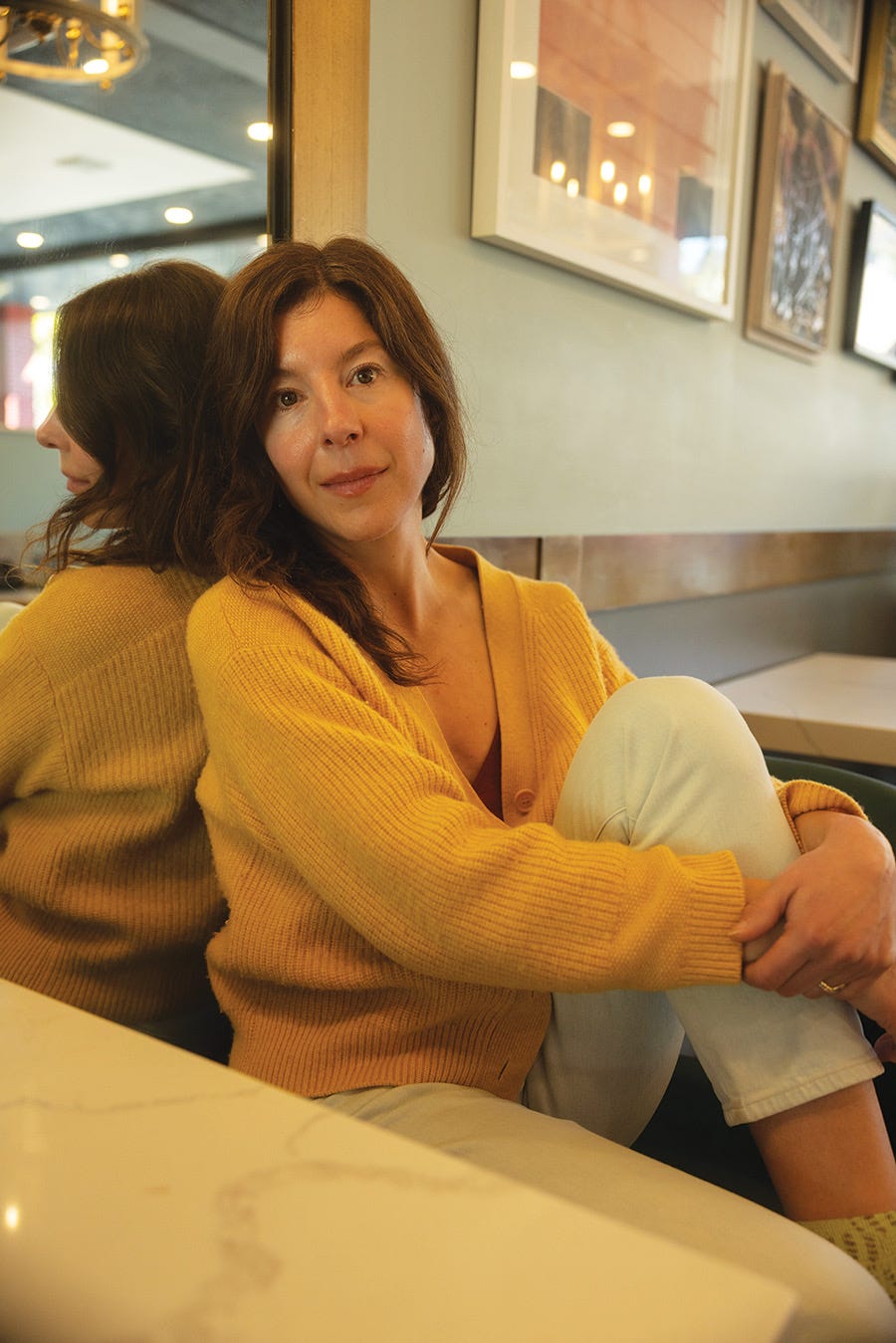
Nora Lange’s debut novel Us Fools was awarded the The Sue Kaufman Prize for First Fiction, was a finalist for the National Book Critics Circle Award in Fiction, was named a best book of 2024 by The Boston Globe and NPR, a Los Angeles Times bestseller, and a New York Times Editors’ Choice. An earlier iteration of it was shortlisted for The Novel Prize from New Directions Press. Nora’s writing has appeared in The New Yorker, Granta, The Believer, BOMB, Hazlitt, Joyland, American Short Fiction, Denver Quarterly, HTMLGIANT. Her project Dailyness was longlisted for the 2014 Leslie Scalapino Award for Innovative Women Performance Writers. She has received fellowships from Brown University and is a fellow at USC’s Los Angeles Institute of the Humanities. She recently moved to Salt Lake City with her family.
Come GIT some!