
The Year in Phrases
some titillaters and nonpareils

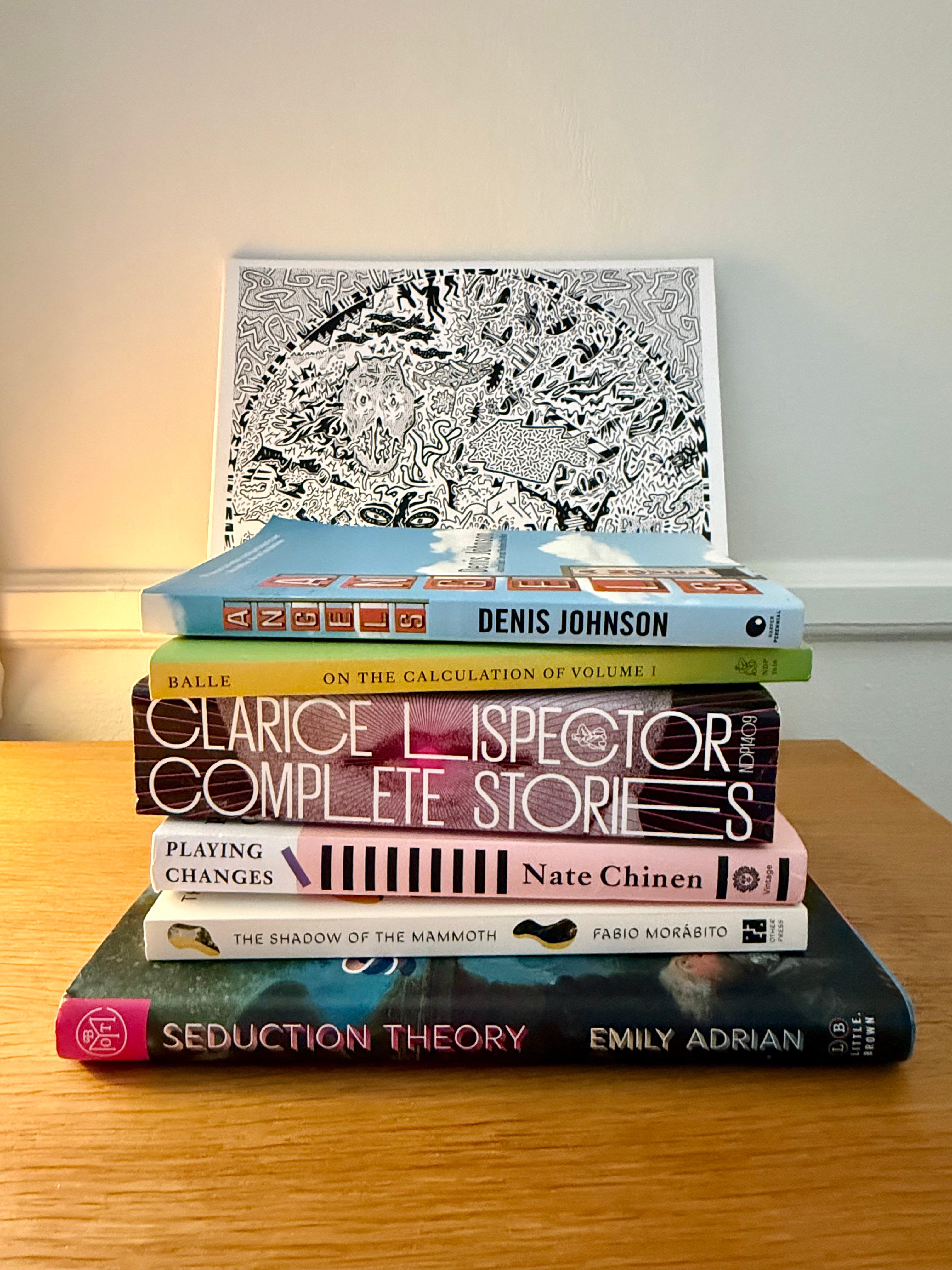
I read a lot of books this year and pecked at exactly forty-two story collections, but nothing lit me up more than the phrase. If a painter’s smallest decision comes down to the single brushstroke, the writer’s is, well, the letter, but the glimmer doesn’t glow until you get to the phrase. A single word might excite some—and I do like some individual words—but more often than not, it’s the music of two or more words or the striking image they create than titillates me or helps me understand a character/voice.
On that note, here are just a handful of phrases that un-balded my head this year.
from Denis Johnson’s Angels:
You think I got problems? Honey lover baby angel, you got more problems figuring out what to do with that rose than I got in my whole fuckin life.
Angels is legend for writers, but I don’t know of many “normal readers” who swoon over Denis Johnson. Jamie is a young mother on the run from her cheating, abusive husband with her two kids on a Greyhound and falling hard and disappointingly fast for the convicted felon Bill Houston, a man with a shrimp tattoo and a bottle of booze. They drink, Jamie pukes, and then she looks at the nuns sitting nearby and out comes this drunken tirade, directing all her disappointment toward them. I love "Honey lover baby angel” for many reasons, but most of all because of its attitude and interiority. This kind of phrase can only come from a well of pain, and we’re frequently let inside this well throughout the novel in moments of her soul-gone-threadbare disassociation. This was my favorite re-read of the year. If you’ve never read this, consider it your book(ish) homework. I’ll take 1,000 words by January 31st.
from Fabio Morábito’s “The Grass at Airports”:
Actually, I couldn’t care less about airplanes. On the other hand, airport grass has fascinated me since I was a little boy. I’ve always been fond of those perfectly delineated stretches of turf, which are far from the splendor of the grass on soccer fields and golf courses; this grass, I’d say, is in a state of waiting, without a precise vocation, a bit like the way I was during my adolescence and most of my youth, ignorant of my aptitudes and unsure of everything. I think I loved that grass because it seemed akin to my being.
The narrator of this deceptively simple story protracts the beginning to wax poetic about grass. Airport grass, it turns out, captures carbon and contributes to the well being of pilots. The narrator loves the grass, studies it, tends to it, believing with deep conviction in its importance. This quick flash of adolescence illuminates his psychic state and adds a delicate texture to the story. I don’t necessarily read to “see myself” in texts, but on the rare occasion I feel true kinship with a character or narrator, I’m stunned into silence. It always feels like I’ve been found out. I too was ignorant of my aptitudes and unsure of everything as a kid—actually, until I was thirty-seven. This story is extraordinary. I forced a few friends to read it.
from Solvej Balle’s On the Calculation of Volume (Book 1):
“The knowledge that everything can change in an instant, that something which cannot happen and which we absolutely do not expect, is nonetheless a possibility. That time stands still. That gravity is suspended. That the logic of the world and the laws of nature break down. That we are forced to acknowledge that our expectations about the constancy of the world are on shaky ground. There are no guarantees and behind all that we ordinarily regard as certain lie improbable exceptions, sudden cracks and inconceivable breaches of the usual laws.
Kafka, Woolf, and Calvino’s abstract purgatories work for me, but on the sentence level, I don’t normally like a pile of abstract words: exceptions, breaches, laws. It’s too much invisibility, and something about it makes me think of rote memorization in tenth-grade Chemistry—miraculously, we didn’t actually have a lab or do hands-on experiments—which I decidedly hated with all my Ramones-loving guts. But there’s something so charming about Balle’s reliving-the-same-day narrator that is so comforting and calming and oddly profound. I hear the phrase “improbable exceptions, sudden cracks and inconceivable breaches of the usual laws” and still don’t exactly know what it means, but it feels and sounds really good, so I’ll just keep repeating it to myself when I’m out on a run or doing the dishes until one day it hopefully clicks. Either way, I’m here for Balle. Don’t let the Groundhog’s Day premise fool you. It’s much more moody and meditative and addictive than you might think.
from Nate Chinen’s Playing Changes: Jazz for the New Century
[Speaking about the experimental band Trio Convulsant]
The group’s lone studio album, Sister Phantom Owl Fish, released on Ipecac in 2004, was a brash, concussive affair informed to no small degree by the doomy churn of underground metal.
Speaking of abstraction, music writing is notoriously laughable. All the swelling and crashing and fuzz and crunch, the ethereal and—somebody stop me—angular. (Yawn.) It all gets so overdone and downright silly. So, when someone gets it right, or hits the bullseye with an evocative few words like “doomy churn,” you feel like you might not even have to hear the music to understand. That’s great writing. Writing about a piece of music should be the great test of any young writer, akin to the young chef attempting the perfect French omelet. This book contains an ocean of jazz from the last thirty years. I felt pretty waterlogged by the halfway point, coughing and gasping to keep up with the innumerable artists I’d never heard of, but by the end I came out much stronger. (I think. Maybe ask my therapist.) Shoutout to my rock ‘n’ roll book club.
from Emily Adrian’s Seduction Theory:
His brothers howled with laughter, they loved him so. Their mom brewed more coffee and cleaned the sink with a smiling sponge called Scrub Daddy. Brian imagined Scrub Daddy as a kind of pervert and Jasper objected, vehemently. The sponge was a father figure. A self respecting man. Ethan enjoyed the intensity of his brother's debate. Behind teal-rimmed drugstore glasses, Lois rolled her eyes.
The authenticating detail here is so well placed. I know exactly who Lois is in this passing moment. Drugstore glasses, rolling her eyes—she’s practical, she’s no-nonsense, she puts up with a lot, she has a sense of humor. Some friends helped me realize I love comic novels maybe more than any other kind of novel, so I leaned into that more as the year came to a close, and this is one comic novel I swooned over. It’s also freaking smart and snappily written. Shoutout to Justin Taylor for the recommendation in our interview.
from “The Smallest Woman in the World” by Clarice Lispector:
It was, therefore, thus, that the explorer discovered, standing there at his feet, the smallest human thing in existence. His heart beat because no emerald is as rare. Neither are the teachings of the sages of India as rare. Neither has the richest man in the world ever laid eyes on so much strange grace. Right there was a woman the gluttony of the most exquisite dream could never have imagined. That was when the explorer declared, shyly and with a delicacy of feeling of which his wife would never have judged him capable:
“You are Little Flower.”
“…the gluttony of the most exquisite dream” is merely one jazz-like phrase from the mountain of jazz-like phrases from the phenomenal Clarice Lispector. Her work constantly makes my head spin. The experience of reading Lispector is akin to biting into meringue for the first time over and over again or listening to Alice Coltrane or John Zorn. Every turn features some strange or dislocating phrase or image. I relished re-reading her Collected Stories this year.
from “The Simple Joy” by Ryan Davis & the Roadhouse Band:
my skull was a dunk tank clown for some schoolyard lass to chastise
my ribcage was a looney bin built to keep my heart out of her hands
“The Simple Joy” is from New Threats from the Soul, one of my favorite records of the year. Davis is the best kind of maximalist, and he treats the line and the phrase like a grab bag of playful things that conjure an accidental-seeming profundity.
How about you? What did you underline this year, honey lover baby angels?
+++
News:
I’m donating all of this month’s paid-subscriber earnings to TC Food Justice, which you can read about here if you’d like.
I’m teaching an upcoming class at The Loft Literary Center in Minneapolis on creating fictional characters if you or anyone you know would like to sign up. The class was originally titled “Clarissa, Take the Wheel,” but the marketing team decided some people might not get it. Welp.
We’ve got a really fun Year in Reading series coming up, which I’ll run in two parts after the holidays.
As always:
Please spread the love to your local libraries, independent booksellers if you can, or shop online at Bookshop.
Happy Holidays, and thanks for reading.
Thank you!