
The Gap
An Invitation to Snobbery

In a January 2023 Oscar round-up, Richard Brody, film critic for The New Yorker, said, “I’m keeping my list in this fantasyland in order to highlight the gap between what’s usually on the Academy’s radar and what’s going on in the world of movies at large.”
I’ve thought about the book world parallel of this statement for the better part of the last three and a half years. It seems like there is a widening gap between what lands on the bestseller lists or celebrity book club picks (some of whom are actually decent pickers), and what’s happening in the world of books at large. Allow me a crude napkin diagram.
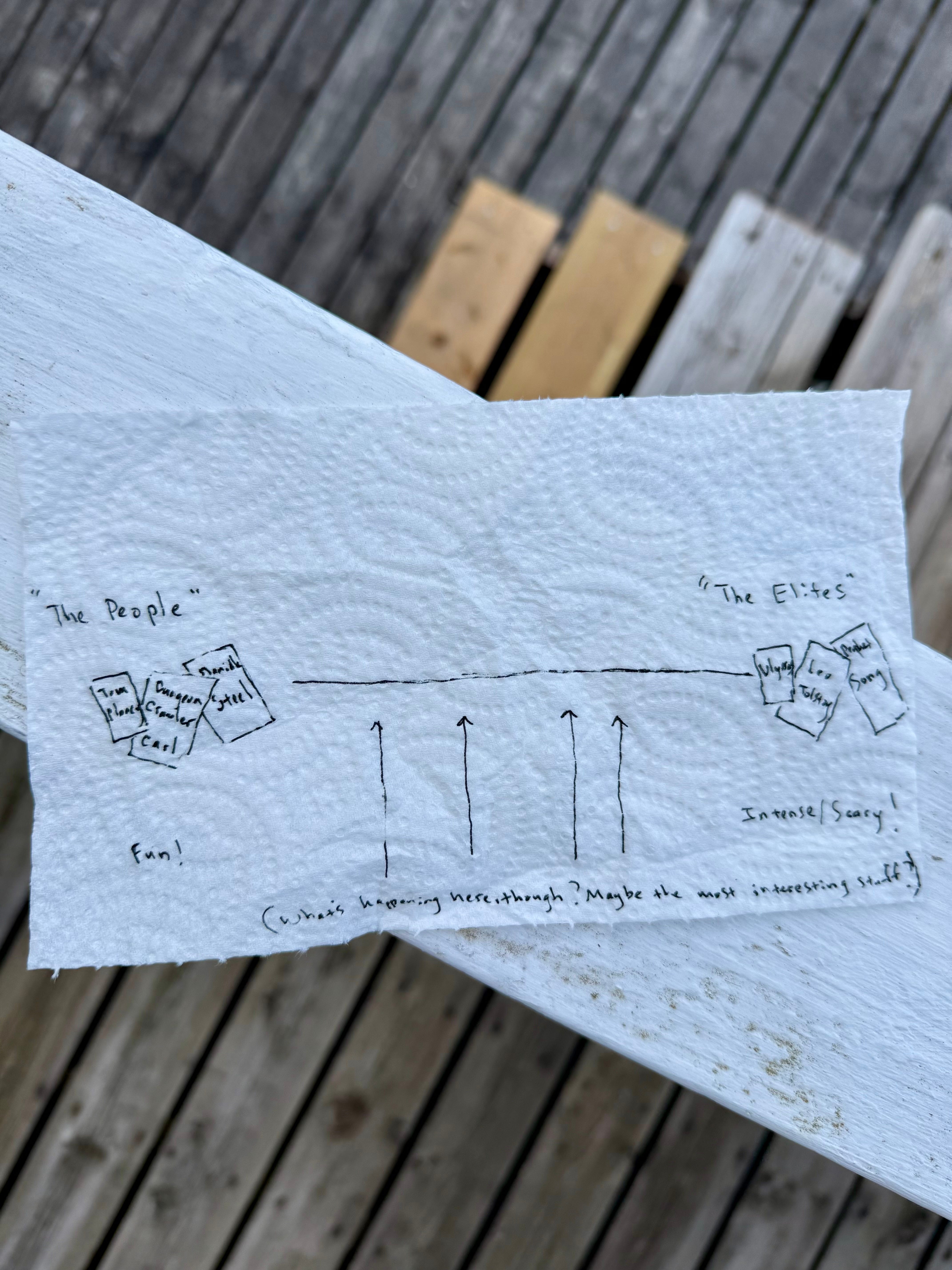
We could break this down in many ways, with branching genres and sub-genres, crossovers and hybrids and surprise bestsellers, but basically we have what is popular, what sells, and what gets massively consumed on one end, and the prize-winning, the syllabus-residing, and the canonized—or eventually canonized—on the other. We have entertainment and we have work. Rarely do the two extremes meet. Imagine The Safekeep in a Walgreens or Danielle Steel at Greenlight in Brooklyn.
As someone who enjoys the risky, the wild and the untamed, the aesthetically adventurous, the dark, the filthy, the morally dubious (see Garth Greenwell’s fantastic essay on Philip Roth’s Sabbath’s Theater, “A Moral Education: In Praise of Filth”), I want people to join me. For better or worse, I’m an enthusiast. So, not only am I feeling internet-y —you’re getting more images than usual (two!) and I’m making you a tidy list—I’m also feeling helpful. Here’s how you might come to the dark side, should you choose to cross over, split your reading time custody, or merely dabble in snobbery.
Embrace discomfort
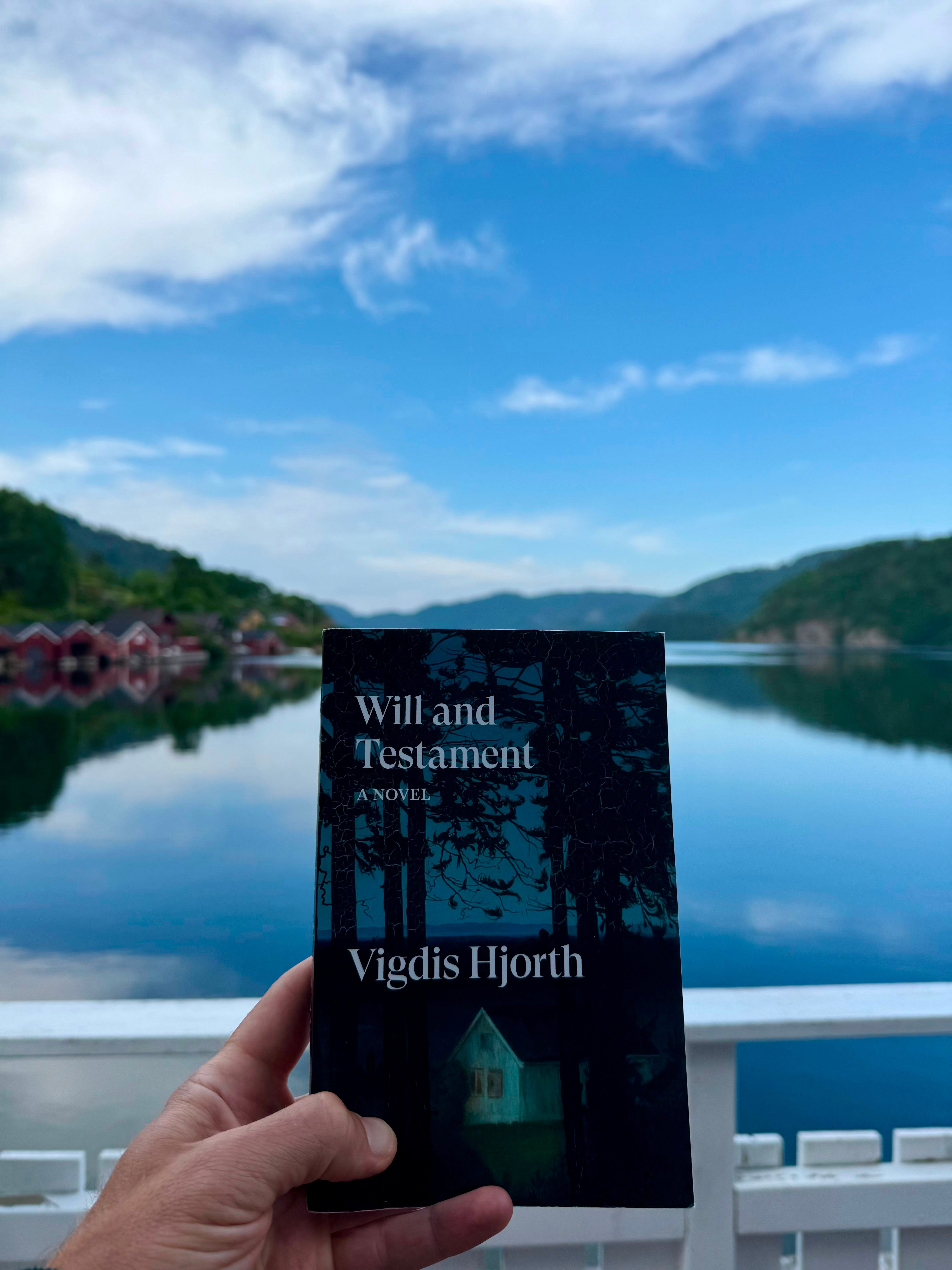
After finishing Vigdis Horth’s Will and Testament recently, I shut the book and took a big breath, turned to my wife Rebekah, and said, “Yeesh. That was a bitter book.” A bitter dispute, a bitter, dead father, a bitter, repressed, and traumatized narrator, a bitter sister. (And even a bitter publication controversy.) After her father dies, Bergljot learns that her and her older brother Bård were left out of the inheritance of the family’s two cabins. Instead, they are willed to her sisters. Bergljot’s psychological tumult—her father sexually abused her when she was very young—surges for 336 pages. Racing thoughts, second-guessing, replaying scenes and conversation, semantic hyper-vigilance, and panic-stricken calls to confidants ensue. Claustrophobia abounds. Is it how I want to live my life? Repressed, anxious, borderline alcoholic? No, but as Greenwell says in his essay, “The moral seriousness […of certain novels] lies in their refusal of an image one might identify with in any frictionless, any merely self-comforting way.” Characters aren’t supposed to be propaganda for good behavior.
Splash Around
So, Hjorth’s tale of incest and psychological torment isn’t for you? Great. Try something else. Actually, you could even try her Long Live the Post Horn!, full of equally cyclical thoughts and meandering dread, but wry and much lighter on its feet. The playground is varied. Skippy Dies (a hysterical boyhood romp), Cursed Bunny (surreal fables), and The Butcher Boy (a killer’s descent into madness) were all nominated for The Booker Prize—an example of one prize’s breadth—but are as varied as the ramen aisle at H Mart. There is much muchness in the literary landscape (unless Less is your thing, in which case, I wouldn’t fault you). 1
Don’t Be Afraid to Look Stuff Up
Actually, I’m right there with you. I recently picked up New Poets of Native Nations, an anthology of twenty-one contemporary Native poets by the formidable Graywolf Press. The very first poem in the book is “Anasazi” by Tacey M. Atsitty. I read it, liked its rhythms and images, but admittedly couldn’t make much sense of it. (First of all, images and rhythms make their own kind of sense, and if you want to lean into that, or rest on that, I think that’s a perfectly fine way to enjoy things. Don’t let the Highest of the High Hobnobbing Snobs tell you where to stand and how to hold your hat. There are no rules about how to enjoy literature or fall in love.) So, what did I do? I got on my looking-up machine and typed in “Anasazi meaning.” Ah. According to the The Indian Pueblo Cultural Center, the word “anasazi” is an outdated term. Here’s what I learned:
The term “Anasazi” was established in 1927 through the archaeological Pecos Classification system, referring to the Ancestral Pueblo people who spanned the present-day Four Corners region of the United States, including Mesa Verde, Chaco Canyon, Canyon De Chelly, and Aztec. The term is Navajo in origin, and means “ancient enemy.” The Pueblo peoples of New Mexico understandably do not wish to refer to their ancestors in such a disrespectful manner, so the appropriate term to use is “Ancestral Pueblo” or “Ancestral Puebloan.”
Now I had a door into the poem. I read it again. Do I have total and complete understanding? It’s a fool’s errand to think we ever will. You try your best to understand the intention of the work, enjoy what you can, and thank your lucky stars that you have leisure time in the first place.
Don’t Be Afraid to Look Stuff Up Also Means Don’t Be Afraid to Work a Little
No further explanation needed.
Not All “Serious Literature” Requires Hard Labor
Steinbeck, Frankenstein, The Mothers and Americanah—it’s not all sweat and heavy lifting. Some of the highest of the high go down easy. (Please refer to number two. Keep splashing.)
Use Tricks, Get Some People
Try the Pomodoro Technique with Virginia Woolf. Or five pages a day in the same chair at the same time with Ulysses. Mess with functional fixedness: Read upside-down, listen on audio for five minutes, and read for five minutes, or X-Acto knife that hefty novel into fifty-page booklets. Get yourself a book club and a deadline.
+++
We have this rule with our daughter that might sound familiar, a rule that often devolves into firm recommendation, because rules schmules. It goes like this: When we make a new dish, you have to try it. You don’t have to like it, but you never know if you might like kimchi, grilled asparagus, or watermelon radishes until you try them, so why not give yourself over, however briefly, to adventure? You might find out about your own mind, your capacity for endurance, or your affinities and repulsions—which in and of themselves have much to teach.
For a long time I thought something was wrong with me. Why couldn’t I enjoy good old-fashioned entertainment? I’ve tried to widen my horizons in the last few years, to move toward “The People.” I’ve tried crime, romantasy, and Michael Crichton’s Jurassic Park. And, you know what? It’s mostly not for me, but I did read the Heartstopper graphic novels with my daughter and liked those, and I love Asher Perlman’s collection of comics. Most of the time, though, if I want rest or soul candy, I’d rather sit and listen to the birds in my little backyard, jog to Lady Gaga, or give myself over to corpse pose. (A truly wonderful pastime.) I do have my own comforts, which I’ve written about before, but I also have my snobbery, which feels like home. What titles are made into towers at the front of the big box bookstores? It’s not all that interesting to me. But what’s happening in the world of books at large is. And maybe that, more than anything, is what this is all about—being comfortable in your own skin.
You don’t have to force yourself to swing any which way in the Napkin Spectrum™️, but it’s probably in your interest to keep trying, because as much as the self is a home, the self is also something to shake off every now and then.
The gap will likely always be with us, but in the landscape of American literary consumption, it feels wider than ever. We’re all digging our heels in—the people and the elites alike—but it doesn’t have to stay that way.
I’m curious: Where does home feel like for you?
+++
As always, please spread the love to your local libraries, independent booksellers if you can, or shop online at Bookshop. Thanks for reading.
Is Less lesser? Lesser than what? (This is mostly a joke—I’m yolked to the joke.) It’s neither here nor there. Elitism is a construct. Prizes are made of juries and cultures of taste.